A narrow but real opening has emerged to prevent Georgia from slipping out of the democratic world. The United States and Europe should not miss it.
Recently, nine pro-Western opposition parties in Georgia signed an agreement to coordinate their efforts against the ruling party, Georgian Dream.
The parties remain separate, but they have committed to a shared strategy aimed at restoring democratic institutions and returning the country firmly to its Euro-Atlantic path.
For a country whose opposition has long been divided and distrustful, this is a significant development.
It may represent the most meaningful unity among Georgia’s pro-Western political forces since the Rose Revolution more than two decades ago.
Georgia sits at a strategic crossroads between Europe, Russia, and the Middle East, along the eastern edge of the Black Sea.
If its democracy collapses, the Kremlin gains influence along the Black Sea — sending another signal that Western commitments in the post-Soviet space are negotiable.
Saakashvili a spent force
The coalition also creates an opportunity for Georgia’s democratic opposition to move beyond the political era of Mikheil Saakashvili.
Once a transformative democratic leader, Saakashvili is now a spent force in Georgian politics whose continued prominence has often deepened divisions among opposition parties. A broader coalition offers the possibility of new leadership and a fresh start for the country’s democratic movement.

Meanwhile, Western governments are beginning — belatedly — to show signs of seriousness about Georgia’s democratic backsliding.
The European Union has already imposed consequences on senior Georgian officials, including suspending visa-free travel privileges for government representatives after repression of civil society and concerns about the integrity of elections.
In Washington, the political landscape may soon shift as well.
Legislation targeting Georgian officials responsible for democratic repression has circulated in Congress for months. If senator Markwayne Mullin — president Donald Trump’s nominee to become the new secretary of the Department of Homeland Security — leaves the Senate to join the administration, the principal obstacle to movement on that sanctions bill could disappear.
If Mullin’s nomination moves forward, his confirmation hearings will give Senate colleagues an occasion to publicly reaffirm support for Georgia and the pending sanctions legislation, and to question why he resisted efforts to send a stronger signal to the Kremlin as democratic freedoms were undermined in a neighbouring state.
Individually, these developments may seem modest. Together, they create something essential in foreign policy: leverage.
Georgia’s democratic future has not yet been decided. But the window to preserve it may not remain open for long.
From success, to state capture
Georgia was once the West’s brightest democratic success story in the former Soviet Union. Today, it is drifting toward state capture under a government whose governing style increasingly resembles Moscow more than Brussels.
Georgia’s democratic erosion did not happen overnight. It unfolded gradually through a mix of internal political decay and Western indifference.
Billionaire Bidzina Ivanishvili and his Georgian Dream party first came to power promising to correct the excesses of the previous government.
Instead, over time, they consolidated control over key institutions, weakened judicial independence, and created a political system that critics increasingly describe as oligarchic rule.
The government still speaks the language of European integration even as it undermines the institutions that make that integration possible.
The process has accelerated in recent years. The passage of a foreign agents law modeled on Russian legislation has placed journalists and civil society groups under growing pressure. Elections have become more opaque. Independent institutions face mounting political interference.
Yet the Georgian public has shown remarkable resolve.
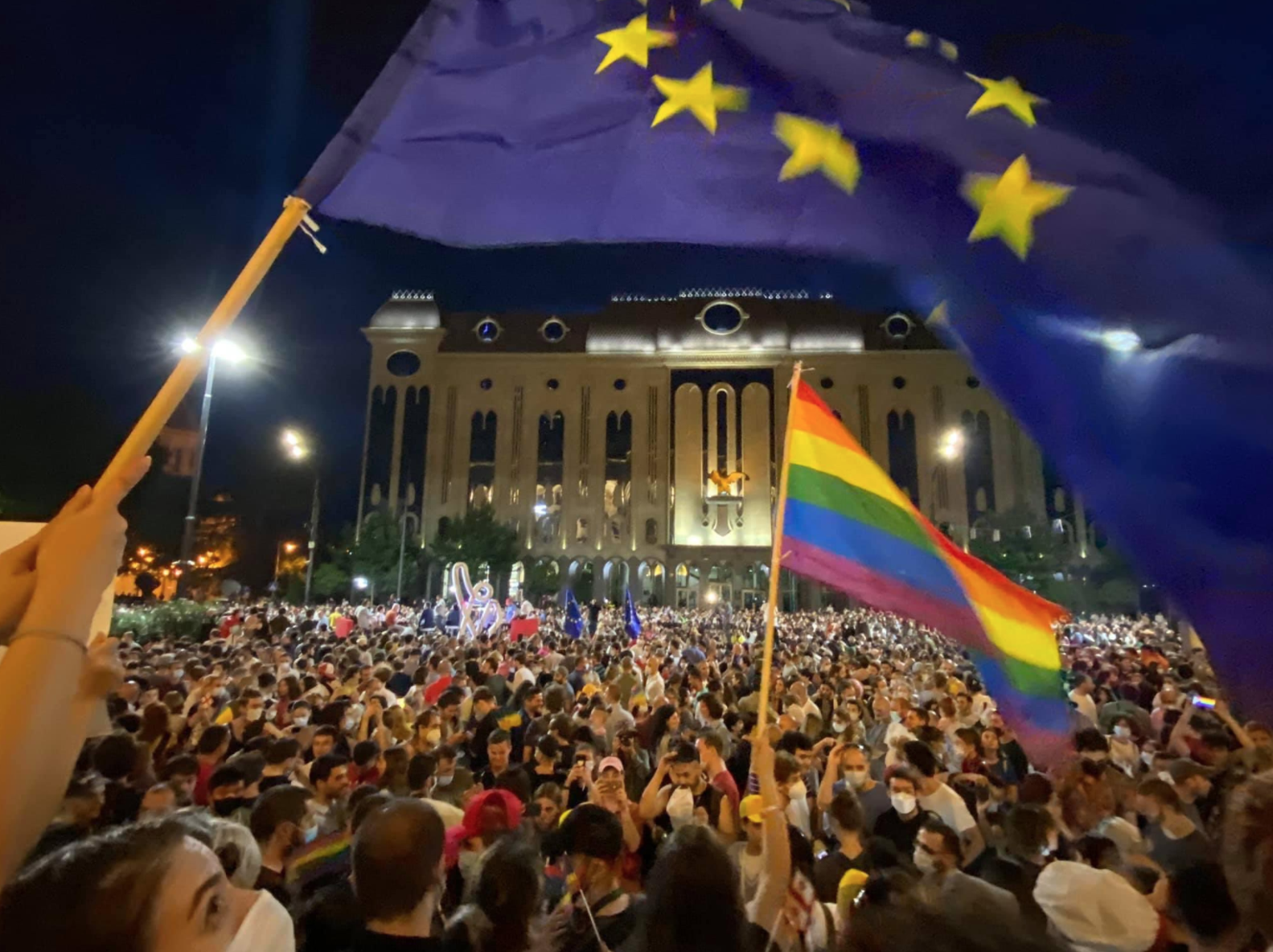
Tens of thousands have repeatedly filled the streets of Tbilisi carrying both Georgian and European Union flags, insisting that their country belongs firmly in the democratic West. Few countries in Europe display stronger public support for membership in the European Union and Nato than Georgia.
The divide in Georgia today is not between East and West. It is between the government and much of its own society.
The West’s own strategic misjudgments helped create this moment.
First-hand experience
I first traveled to Georgia in 1995 and later worked on the country in several US government roles, including the Senate Foreign Relations Committee, the National Security Council, and the State Department, where I served as deputy assistant secretary during Russia’s 2008 invasion of Georgia.
From that vantage point, the erosion of Western attention over more than a decade has been striking.
The Obama administration’s Russia reset treated the invasion of Georgia less as a warning about Moscow’s ambitions than as an obstacle to broader diplomacy with the Kremlin, particularly negotiations over Iran’s nuclear program.
Europe made a similar mistake. German chancellor Angela Merkel’s strategy of engagement with Moscow — built on energy ties and economic interdependence — rested on the hope that economic integration would moderate Russian behaviour.
In that environment, Georgia slowly slipped down the list of Western priorities.
The result was predictable enough. As Western attention faded, democratic safeguards weakened and Russian influence quietly expanded.
That history explains how Georgia arrived at this precarious moment. The question now is whether the West will use the leverage it has.
Targeted sanctions against officials responsible for democratic repression would send a clear signal that dismantling democratic institutions carries real consequences.
Coordinated pressure from Washington, Brussels, and London could reinforce the message that Georgia’s future still lies with the democratic world.
Importantly, the West should make clear that its support rests not with any particular political party but with the Georgian people themselves, whose commitment to democratic values has never wavered.
Russia understands Georgia’s strategic value. The Georgian people do too. The real question is whether the West will act in time to help them keep their country in the democratic world.
This article was first published on: https://euobserver.com/206101/georgia-is-not-lost-if-the-west-acts-now/


Kazakhstan and the End of the Multi-Vector Moment
The Strait of Hormuz and the Power of Chokepoints
